New research shows how 鈥榟ot electrons鈥� can reshape metals in billionths of a second
Researchers at 花椒直播 have revealed how intense electronic excitation can trigger rapid structural changes in metals 鈥� without heating the atomic lattice 鈥� offering new insight into ultrafast materials behaviour.
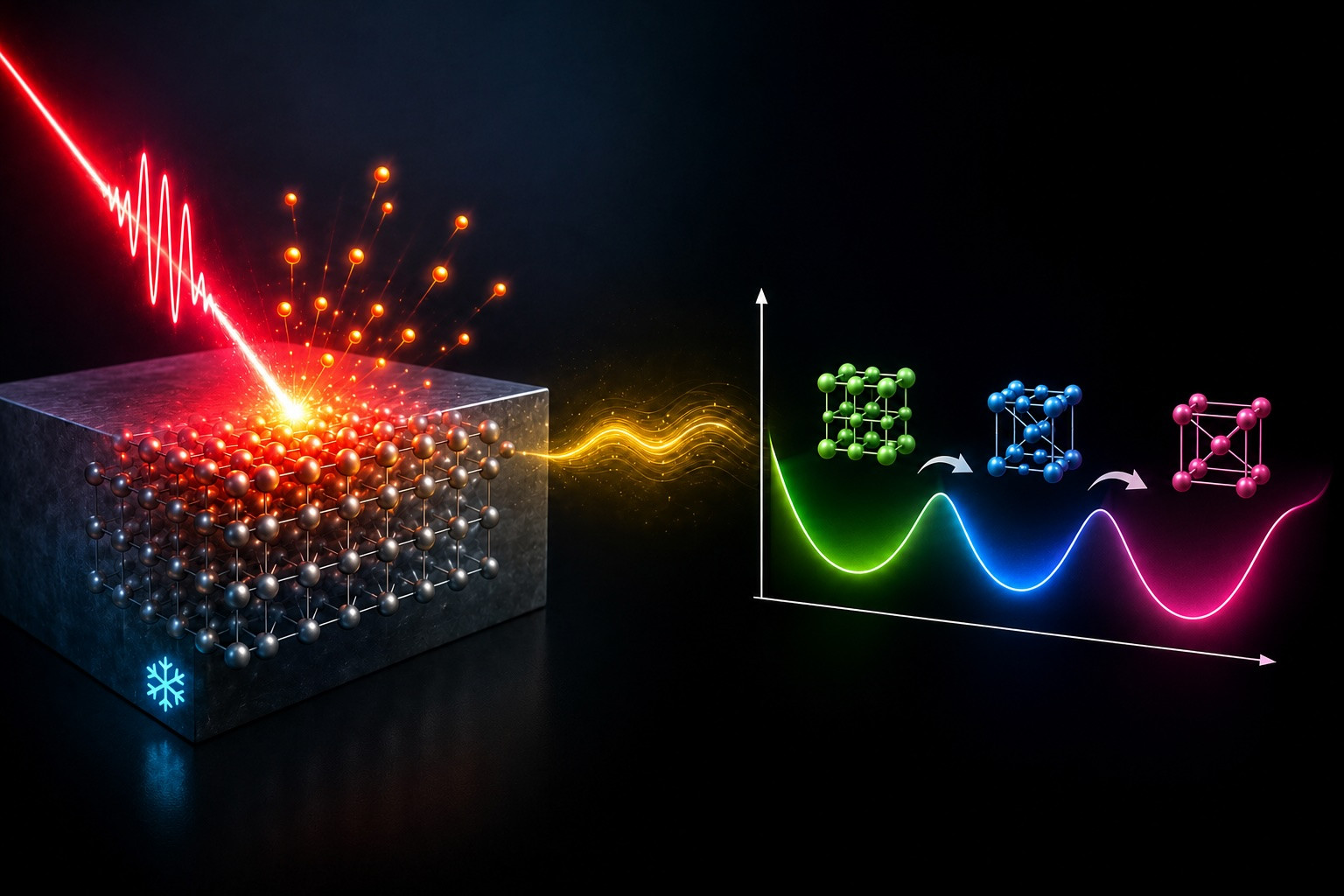
When metals are exposed to powerful laser pulses, their electrons can heat up almost instantly, reaching extreme temperatures while the atoms themselves remain relatively cold. This study shows that, under these conditions, the behaviour of the material is driven not by heat in the traditional sense, but by changes in the electronic system.
Published in , the research, led by demonstrates that this electronic 鈥渞eheating鈥� alone can cause metals to switch between different crystal structures in a fraction of a picosecond.
A different way to drive phase changes
In most phase transitions 鈥� such as melting or structural rearrangement 鈥� heat flows through the lattice of atoms. But in this work, the team shows that another mechanism can dominate: electronic entropy, a measure of how electron populations spread across energy states at high temperatures.
By modelling 17 different elemental metals, the researchers found that almost all undergo one or more solid-to-solid phase transitions driven purely by this electronic effect.
This means materials can change structure before the atomic framework has time to respond, creating a short-lived but physically meaningful state governed entirely by electronic properties.

Our results suggest that electronic entropy should be regarded as a thermodynamic control parameter in its own right. Just as external pressure can transform one crystal structure into another, strong electronic excitation can reshape the free-energy landscape and create entirely new phases of matter.
Predicting how metals respond under extreme conditions
The team used advanced simulations to calculate how the free energy of different crystal structures changes as electronic temperature rises. These calculations revealed consistent patterns across groups of metals, including transitions between common structures such as hexagonal (hcp), face-centred cubic (fcc), and body-centred cubic (bcc).
A key finding is that increasing electronic temperature tends to favour structures with lower density, driven by an effect known as electronic thermal pressure.
However, the behaviour is not universal. In some elements, subtle differences in electronic structure (especially the distribution of electrons near the Fermi level) lead to more complex or unexpected phase changes.
Understanding materials on ultrafast timescales
These results help explain how metals behave under extreme, nonequilibrium conditions, such as those created in laser experiments or high-energy environments.
Because the transitions occur on femtosecond to picosecond timescales, they could be observed using ultrafast experimental techniques, including time-resolved X-ray or electron diffraction.
The findings suggest that researchers may be able to use ultrafast laser pulses to temporarily switch materials into new structural states, opening possibilities for controlling material properties in ways not accessible under equilibrium conditions.
Toward new approaches in materials design
By showing that electronic entropy alone can drive structural changes, the study provides a new framework for understanding and designing materials under extreme conditions.
The research could inform future developments in areas such as ultrafast electronics, high-energy physics, and advanced manufacturing technologies, where materials are routinely pushed far from equilibrium.
This research was published in: Physical Review Materials
Full title of the paper: Electronic-entropy-driven solid-solid phase transitions in elemental metals
DOI: 10.1103/nzv9-dskm
URL: