
Built for the world: when academia and industry meet
From the Manchester Mark I to robots in hazardous environments and flapless flight, long-term partnerships between academia and industry turn research breakthroughs into technologies built for the real world.
In 1949, two researchers from the University of Manchester did something unusual. Geoff Tootill and Alec Robinson left their academic posts and joined Ferranti Ltd, not to abandon their research, but to take it somewhere it could be built.
They had been working on the Manchester Mark I, an experimental computer which proved, for the first time, that a machine could store and run a program. But testing in a university laboratory and making in the real world were different things at the time.
Robinson soon redesigned the machine's multiplier (the component that handles calculations), so that instead of working through each step one at a time, like traffic queuing in a single lane, his version could tackle several steps, or switch between several lanes, at once. This updated machine ran at five times its original speed, and the result, delivered to the University in 1951, was the world's first commercially available general-purpose computer.
By uniting the two worlds of industry and academia, the researchers had helped to produce something neither party could have achieved alone. Seventy-five years on, universities and industry are now working in a far more direct and collaborative way, to produce equally valuable technologies.
From the lab to the field
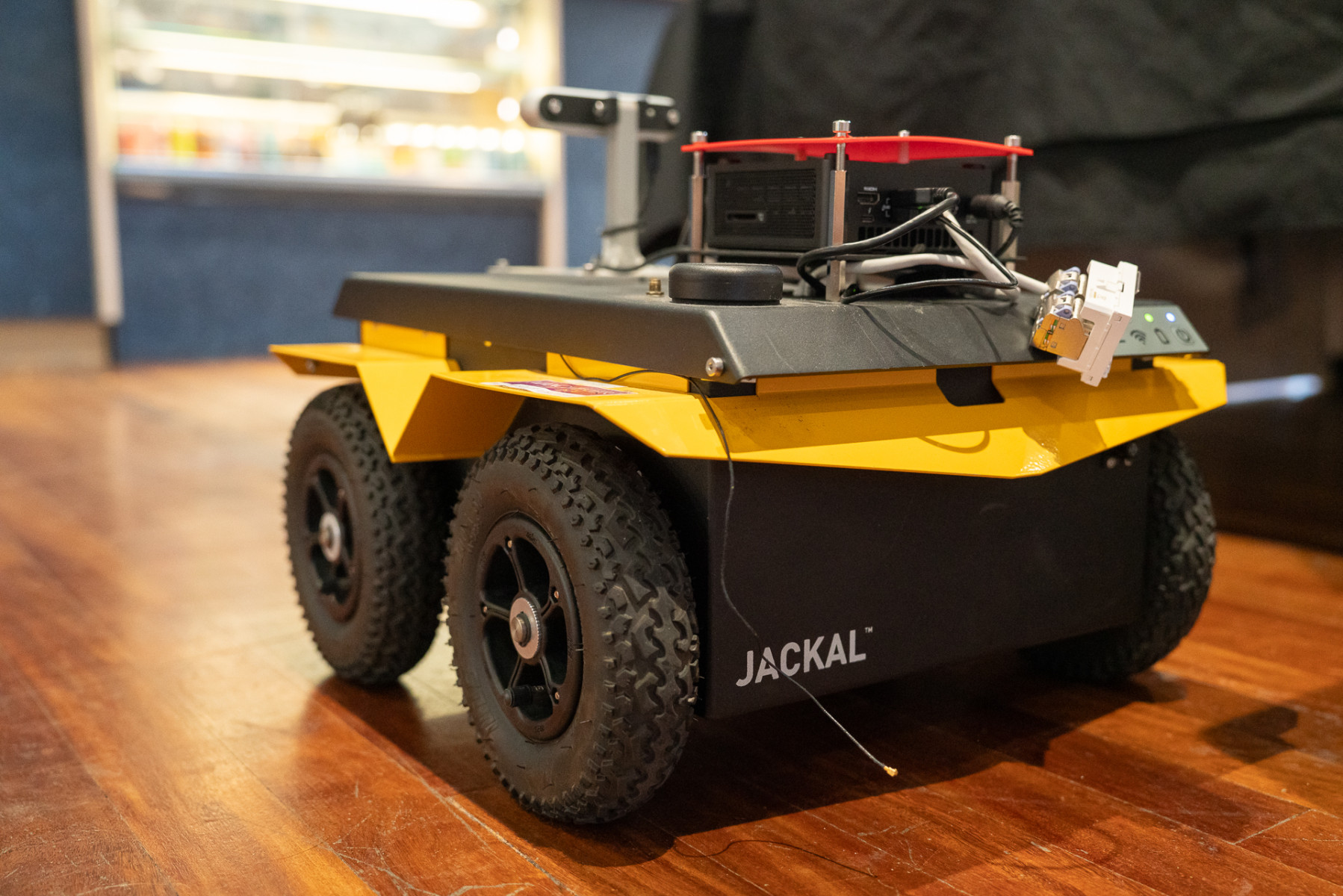
One of the most striking examples at Manchester is , the Centre for Robotic Autonomy in Demanding and Long-lasting Environments. Funded jointly by engineering and technology company Amentum and the Engineering and Physical Sciences Research Council's Prosperity Partnerships programme, the purpose of CRADLE is to design advanced robotics and autonomous systems for environments that can push them to their limits.
CRADLE鈥檚 robots have operated more than 1km underground at the Boulby Laboratory in Yorkshire, in conditions designed to mimic the surface of Mars, and competed in the European Space Agency鈥檚 challenge to develop excavation systems for the Moon. They鈥檝e also been deployed by National Highways to inspect motorway infrastructure in otherwise dangerous situations for human engineers.
Another successful project was (Robotics and Artificial Intelligence in Nuclear), a five-year programme funded by UK Research and Innovation, which saw Manchester's Centre for Robotics and AI lead other research institutions in working directly with nuclear sector organisations, including Sellafield Ltd, EDF Energy and the UK Atomic Energy Authority.
They developed autonomous systems that could inspect, handle and maintain equipment remotely when in environments too hazardous for people, something that makes a huge difference to the safety, cost and speed of clean-up in industry phases like nuclear decommissioning.
A different kind of partnership
Not all collaboration looks the same, often these are long-term partnerships built on trust and a shared purpose, rather than short projects with a single deliverable.
Manchester's work with BAE Systems, for example, spans several decades and multiple projects, like the FLAVIIR programme which led to the world's first flapless flight. This new aircraft design could be steered by carefully controlling the flow of air across a wing, rather than using moveable flaps and surfaces that conventional planes depend on.
MAGMA further developed this into a method for flying an unmanned aircraft with no moving control surfaces at all, by using air blown at supersonic speed and a technique called fluidic thrust vectoring (redirecting the force of a plane engine鈥檚 thrust by shaping airflow rather than by physically angling its exhaust).
Tootill and Robinson crossed the boundary between academia and industry in 1949 because their work demanded it. Today鈥檚 researchers pushing those boundaries again, working in underground laboratories, nuclear facilities, flight test centres and road networks to navigate difficult problems, building partnerships that produce real-world impacts.