Elusive uranium 鈥榮andwich鈥� cation isolated after more than 50 years, revealing how electron sharing holds its shape
University of Manchester chemists have isolated the oxidised form of the landmark uranium molecule uranocene and show that, in this form, electron sharing between uranium and carbon prevents the molecule from changing shape.
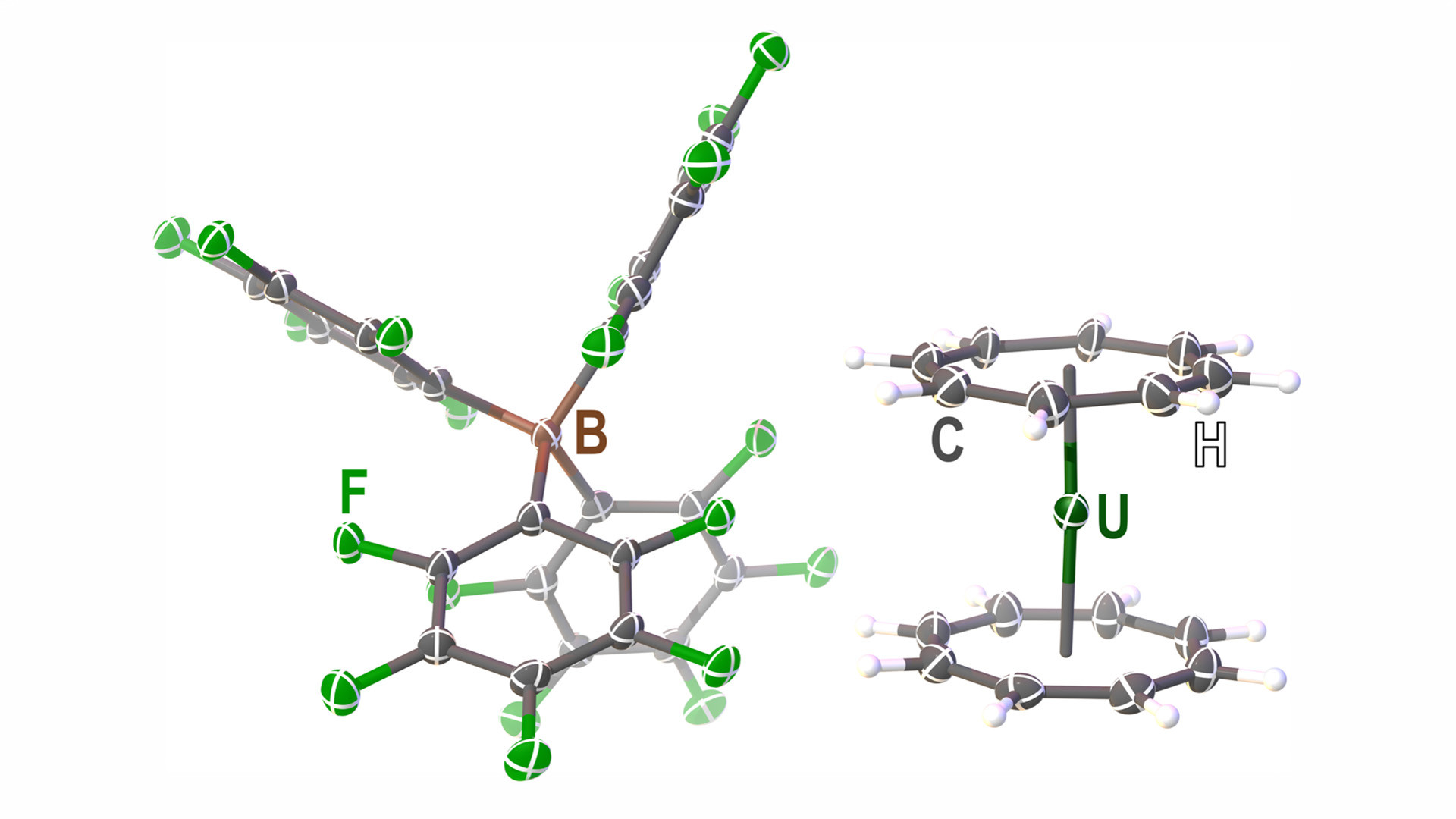
- Researchers have isolated uranocenium, the oxidised form of the landmark uranium sandwich compound uranocene, resolving a question that has remained open since uranocene was first made in 1968.
- The team showed that earlier attempts failed because the cation reacts with a commonly used electrolyte, not because it is inherently unstable. Under the right conditions, uranocenium is stable and electrochemically interconverts with uranocene as ferrocene, the benchmark redox pair in chemistry.
- Spectroscopic, magnetic and computational studies confirm a uranium(V) centre. They also reveal that increased electron sharing (covalency) between uranium and carbon stops the molecule from changing shape when it is oxidised, a rare case where covalency, rather than ionic attraction, governs the structure of an actinide compound.
- Published in Nature Communications, the work completes the uranocene鈥揻errocene analogy that has shaped actinide organometallic chemistry for decades. It also provides a well-defined platform for studying how uranium鈥檚 5f electrons take part in bonding across three oxidation states.
In a study published in , researchers from 花椒直播 and Lancaster University have isolated and characterised uranocenium, the positively charged form of a landmark uranium compound called uranocene. The work shows that this long-sought molecule is stable, and that it behaves in a way that challenges how chemists usually think about bonding in heavy elements.
Uranocene is a 鈥榮andwich鈥� molecule: a single uranium atom held between two flat rings, each made of eight carbon atoms. It is the uranium counterpart of ferrocene, an iron sandwich molecule whose discovery contributed to the 1973 Nobel Prize in Chemistry. Ferrocene readily gives up an electron to form the ferrocenium cation, a switch so clean and reliable that it is used as a reference standard in laboratories worldwide. Until now, no one had been able to isolate the equivalent uranium compound.
Solving a decades-old puzzle
When chemists first tried to remove an electron from uranocene in the late 1970s and early 1980s, the molecule appeared to fall apart, giving poorly defined products. The Manchester team found that the problem lay not with uranocene itself, but with a fluorine-containing salt routinely used in those experiments to help solutions conduct electricity better, an electrolyte. The uranocenium cation strips fluorine from this salt and decomposes in the process.
By choosing a different chemical to remove the electron and a less reactive solvent, the team isolated uranocenium as crystals stable at room temperature. The breakthrough began partly by chance: the reaction was designed for a different purpose, but uranocenium was produced instead.
The team, including Cameron Deakin, Iulia Turcas, Benjamin R茅ant, Liam Griffin,, Adam Brookfield, , and from Manchester, and Dr Andrew Kerridge from Lancaster University, then studied the compounds in detail. They used single-crystal X-ray diffraction, which maps the positions of atoms in a crystal, alongside magnetic and electron paramagnetic resonance (EPR) measurements, which probe the unpaired electrons inside a molecule, and computer modelling. Together, these confirmed that the uranium has given up one more electron than in uranocene, raising its 鈥榦xidation state鈥� from +4 to +5.
Electrochemical experiments, which measure how easily a molecule gains or loses electrons, showed that uranocene and uranocenium switch back and forth as cleanly as ferrocene and ferrocenium do. This signalled to the researchers that the molecular structure barely changes when the electron is added or removed.

Uranocene has been described as the uranium counterpart of ferrocene for more than half a century, but the comparison was incomplete because nobody had isolated its oxidised form. We have now shown that uranocenium is stable when handled correctly, and that it switches between oxidation states as cleanly as ferrocene does. What surprised us most was that the molecule hardly changes shape when it loses an electron, and that turns out to be a direct consequence of uranium sharing its electrons with carbon.
Often, when a metal atom loses an electron, it pulls surrounding atoms closer because its greater positive charge attracts them more strongly. Bonds in uranium compounds are usually held together mainly by this kind of electrostatic attraction, so the team expected the uranium鈥揷arbon distances to shrink noticeably. Instead, X-ray measurements showed they shortened by only around 0.02 脜 (two trillionths of a metre), several times less than expected from the change in uranium-ion size alone.
Computational calculations explained why. When uranium loses an electron, it and the carbon atoms it binds to share electrons much more than in the unoxidised form, a type of bonding known as covalent bonding. The uranium share of the key bonding electrons rises from around 30% to over 40%, whereas normally these carbon atoms would hold onto their electrons much more tightly. This builds up electron density between the uranium and carbon atoms, and because electrons repel one another, the crowding resists any further squeezing together. The two effects balance, leaving the molecule almost unchanged in size, both in crystals and in solution.
Contributing to fundamental chemistry
The findings matter most for fundamental chemistry. Uranocene was one of the first molecules to show that uranium鈥檚 outermost electrons, in so-called f-orbitals, take part in chemical bonding, and it remains a benchmark for understanding how heavy elements bond. With uranocenium, researchers now have a matching set of uranium sandwich molecules in three oxidation states (+3, +4 and +5), allowing them to track changes in bonding while the structure stays almost the same.
The work also provides a rare example where electron sharing, rather than simple electrostatic attraction, controls the shape of a uranium molecule. Next, the team plans to explore the reactivity of uranocenium and to test whether heavier elements, such as neptunium, can form similar compounds.
This research was published in: Nature Communications
Full title of the paper: Isolation of uranocenium, the bis-[8] annulene uranium cation
DOI: